
Coffee History
A journey through centuries: from the Ethiopian legend to modern cafes.
The Legend of Kaldi: The Discoverer of Coffee
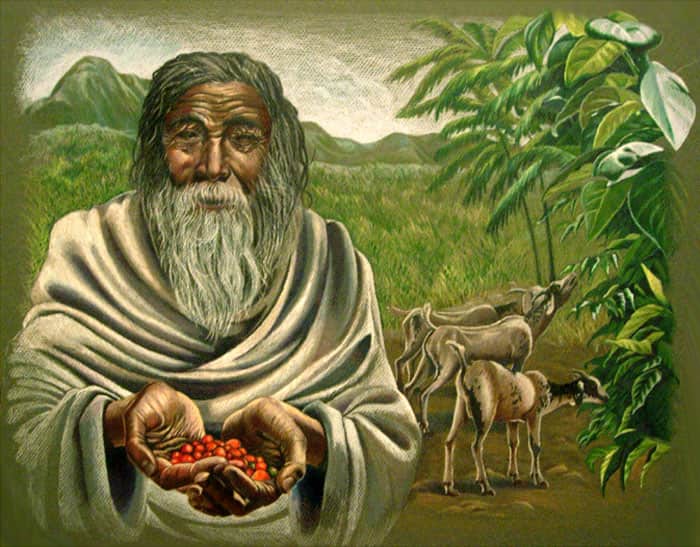
The legend tells that around 850 AD, a young Ethiopian shepherd named Kaldi noticed that his goats became unusually energetic after eating the red fruits of a specific shrub. Curious, Kaldi tried the fruits and felt the same invigorating energy. He took the fruits to a nearby monastery, where the monks initially rejected them and threw them into the fire. A delicious aroma spread, leading them to rescue the roasted beans, grind them and dissolve them in hot water, creating the first cup of coffee in history. The story was only written down in 1671, by professor Antoine Faustus Nairon, and cannot be verified; but it illustrates well how coffee was valued early on for its stimulating properties.
From Ethiopia to the World
Coffee is native to the mountainous forests of Ethiopia, where it grew wild and was consumed in various forms by local tribes long before the legend of Kaldi. The Oromo people chewed the green grains mixed with animal fat to create an energizing paste. Other groups made infusions with the leaves of the coffee plant, called "kati" or "chate", or fermented the fruits to produce an alcoholic drink. These ancestral practices demonstrate that coffee was valued for its stimulating properties centuries before becoming the drink we know today. Although the coffee plant is originally from the Kaffa region in Ethiopia, the word "coffee" has a more complex origin. The term we use today does not come directly from "Kaffa", but through a linguistic adaptation process that accompanied the expansion of the drink worldwide. Until today, Ethiopia maintains a rich coffee culture and produces some of the most distinct grains in the world.
Around the 15th century, coffee was taken to Yemen, where it began to be systematically cultivated. The oldest reliable records of coffee drinking come from Yemeni Sufi monasteries of that time, which used it to stay awake during night prayers. It was here that the drink received the Arabic name "qahwa" (قهوة), a word also used for wine. As it spread through the Ottoman Empire, the term became "kahve" in Turkish and then "caffè", "café" and "coffee" in European languages. The port city of Mocha (Al-Makha) became the main center of the coffee trade, giving rise to the term "café mocha". It was in the Arab world that the habit of roasting, grinding and brewing the beans, as we still do today, took hold.

Diffusion around the World
Asia
In the late 17th century, the Dutch took coffee seedlings from the Malabar coast of India to Java, in Indonesia. The first attempt, in 1696, was lost to a flood; the second, in 1699, succeeded and gave rise to the first large plantations outside the Arab world. Over the 18th century, cultivation spread to Sumatra, Celebes and Ceylon (today Sri Lanka). In India, tradition says that around 1670 the Muslim pilgrim Baba Budan smuggled seven Mocha seeds and planted them in the hills of Chikmagalur.
Europe
Venice, with its intense trade with the East, was coffee's gateway to Europe. By the late 16th century, Venetian travelers and physicians were already describing the drink, and commercial imports began in the early 17th century. According to a popular tradition, around 1600 Pope Clement VIII tasted coffee and approved it for Christians. The first Venetian coffeehouse reportedly opened in 1645. Coffeehouses spread quickly, becoming centers of intellectual and political debate. In Paris, the Café Procope, founded in 1686, attracted figures like Voltaire and Rousseau. In England, "penny universities" allowed anyone to join discussions for the price of a cup of coffee.
America
Coffee arrived in the Americas in the early 18th century, brought by the Dutch and French to their colonies in the Caribbean and the Guianas. In Brazil, the first seedlings were brought from French Guiana in 1727 by Francisco de Melo Palheta. The ideal climate and soil allowed Brazil to become the world's largest producer. In Colombia, Costa Rica and other Latin American countries, coffee transformed entire economies and defined cultural identities.
The Cultural and Economic Role of Coffee
Cultural Revolution
Coffeehouses were important to the Enlightenment and to several political movements. They offered a space where people of different social classes could meet and discuss ideas. Boston's coffeehouses and taverns were meeting points for organizers of the American Revolution, and in Paris the Café de Foy hosted a famous speech shortly before the storming of the Bastille in 1789. Coffee also changed social habits: before it became popular, Europeans commonly drank beer or weak wine throughout the day, and the switch to a stimulating, alcohol-free drink changed urban work and social routines.
Economic Impact
Coffee is one of the most traded agricultural commodities in the world. There are an estimated 12.5 million coffee farms, the vast majority small family holdings in developing countries. Historically, coffee shaped entire economies and influenced colonial policies. Today, movements like fair trade seek to ensure that producers receive a fairer share of the value, while the growing demand for specialty coffee is transforming the global market again.
Coffee Timeline
850 AD
The Legend of Kaldi: The Discoverer of Coffee
The legend tells that around 850 AD, a young Ethiopian shepherd named Kaldi noticed that his goats became unusually energetic after eating the red fruits of a specific shrub. Curious, Kaldi tried the fruits and felt the same invigorating energy. He took the fruits to a nearby monastery, where the monks initially rejected them and threw them into the fire. A delicious aroma spread, leading them to rescue the roasted beans, grind them and dissolve them in hot water, creating the first cup of coffee in history. The story was only written down in 1671, by professor Antoine Faustus Nairon, and cannot be verified; but it illustrates well how coffee was valued early on for its stimulating properties.
Let's learn more?