
Coffee Varieties
Discover the main coffee varieties and how each contributes to unique sensory profiles.
Genetic Diversity
The Coffea genus, known as the "coffee genus," contains over 120 individual species. They are generally shrubs or small understory trees with horizontal branching patterns, opposite and evergreen leaves. The seeds are flat on one side and convex on the other, with a groove on the flat side.
A species is composed of individuals that can reproduce with each other to produce viable offspring. A botanical variety is a level in the taxonomic hierarchy below species and subspecies, with distinct appearance but capable of freely hybridizing with other varieties.
A cultivar is a cultivated variant of a species, originated through human influence. It is a systematic group of cultivated plants that is clearly distinct, uniform, and stable in its characteristics.
A hybrid is the result of crossing between two plants of different species, varieties, or cultivars. In the strictest sense, only the crossing between different species is considered a hybrid.
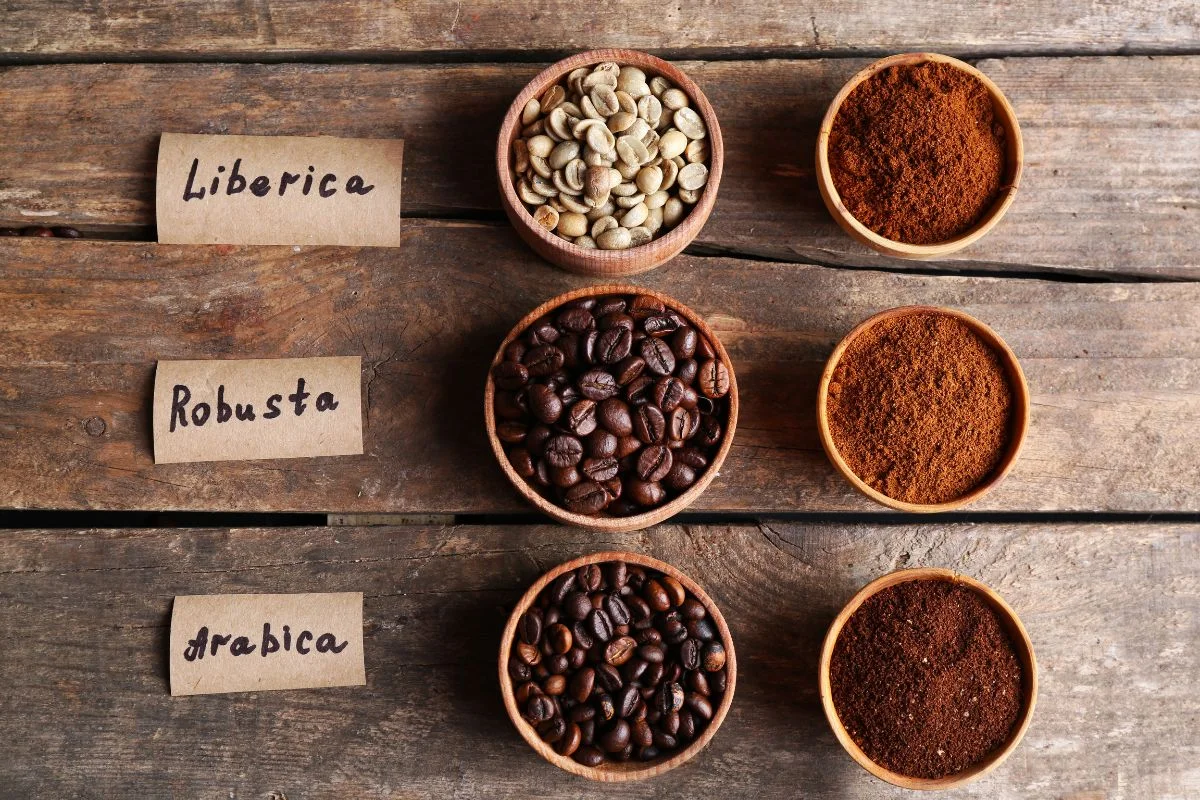
Coffea Arabica
Native to the forests of Ethiopia, it represents about 55-60% of world production. Grown at altitudes between 600-2,000m, it prefers temperatures of 18-23°C. Appreciated for its smooth flavor and complex aroma, but more susceptible to pests and climate variations.
Bourbon
Cultivar that developed naturally on Île Bourbon (now Réunion) from coffee brought from Yemen by the French. These plants have broader leaves and rounder fruits and seeds than Typica varieties.
Stronger and more erect stems than Typica, susceptible to all major diseases and pests · Red Bourbon (Red), Yellow Bourbon (Yellow), Bourbon Pointu/Laurina (natural mutation with conical shape)
Typica
Coffea arabica, native to Ethiopia, was first transported to Yemen. From there, what we now call Typica came from plants taken to Java and neighboring islands, after first passing through India, where, according to tradition, the pilgrim Baba Budan planted seeds brought from Mocha. The Dutch took seedlings from Malabar to Java in the late 17th century, and from there they spread around the world in the early 1700s.
Bronze young leaves, large fruits and seeds, low productivity · Java (resistant to CBD), Maragogype (1870 mutant), Kent (first selection for rust resistance)
Mundo Novo
Cultivar selected from a natural cross between Sumatra (Typica) and Red Bourbon in Brazil in the 1940s by IAC.
Good productivity, some susceptibility to pests · Acaia, Ouro Verde
Caturra
Natural mutation of Bourbon discovered in Minas Gerais, Brazil, between 1915 and 1918. Dwarf plant with short internodes; IAC began selecting it in 1937.
High productivity, susceptible to diseases · Brazil, Colombia, Central America
Catuaí
Cultivar developed by IAC in Brazil, originated from a cross between Mundo Novo and Yellow Caturra made in 1949. Released in 1972.
Dwarf size, red or yellow fruits · Red Catuaí, Yellow Catuaí
Gesha/Geisha
Wild coffee collected in the 1930s in the Gesha region of Ethiopia. It became famous in 2004, when Hacienda La Esmeralda in Panama won the Best of Panama with it.
Exceptional sensory profile, susceptible to rust · Intense floral, bergamot, jasmine
SL28 and SL34
Varieties developed by Scott Laboratories in Kenya. They are the basis of famous Kenyan coffees and were used in the development of Batian.
High cup quality, intense acidity · Black currant, wine, red fruits
Coffea Canephora (Robusta)
Native to the forests of West and Central Africa, it represents about 40% of world production. Grown at lower altitudes (200-800m), it tolerates higher temperatures (24-30°C). Greater resistance to pests, higher productivity, and higher caffeine content. More intense and bitter flavor, widely used in blends and instant coffee.
Conilon
Main variety cultivated in Brazil, especially in Espírito Santo. Adapted to hot and humid climates. Represents most of Brazilian Robusta production.
High productivity, disease resistant, higher soluble solids content
Nganda
Traditional form from Uganda, one of Robusta's homelands. It has a spreading habit and broad leaves; the upright form is called Erecta.
Spreading habit, good adaptability, resistant
Kouillou
A group of canephoras from the Kouilou River region, between Gabon and Congo. The name "conilon" comes from a misspelling of Kouilou.
Rusticity, good production even in less favorable conditions
Vietnamese Robusta
Selections developed in Vietnam, the world's largest Robusta producer. Adapted to humid tropical climate.
High productivity, adapted to low altitudes
Hybrids and Resistant Varieties
The Timor Hybrid revolutionized the development of resistant varieties:
Timor Hybrid
A spontaneous cross between C. canephora (Robusta) and C. arabica var. Typica that occurred naturally on the island of Timor in Southeast Asia. These "Arabusta" hybrids probably originated from a single Robusta parent plant. Found on Timor around 1927, it became popular on the island in the 1950s due to its natural resistance to rust. Collected in Timor in 1978 and planted on the islands of Sumatra and Flores shortly after.
Catimor
Group of cultivars originated from the cross between Timor Hybrid and Caturra. Distributed since the 1980s, it is highly productive and shows resistance to rust and coffee berry disease (CBD). One of the first widely available Catimor varieties was CR (Costa Rica) 95, released around 1995.
Colombia
Cultivar developed by mixing several Catimors, released around 1985. It has rust resistance, but due to its genetic composition, it is relatively unstable as a consistent cultivar. In Colombia, it has been popular to replace it with Castillo.
Sarchimor
Group of cultivars originated from the cross between Villa Sarchi and Timor Hybrid. Lineages such as IAPAR 59, Tupi, and Obata show good rust resistance; some are also resistant to CBD.
Regional Identification
Some varieties are characteristic of specific regions:
🇪🇹 Ethiopia
Local landraces and JARC selections such as 74110 and 74112
🇰🇪 Kenya
SL28, SL34, K7, Ruiru 11, Batian
🇮🇳 India
Kent, S795, Devamachy
🇧🇷 Brazil
Mundo Novo, Catuaí, Bourbon, Icatú
🇨🇴 Colombia
Castillo, Colombia, Tabi
🇮🇩 Indonesia
Typica, S795 (Jember), Ateng, Sigarar Utang
The Future of Coffee and Climate Change
Climate change represents a significant challenge for global coffee production, especially for Arabica. Studies indicate that, under current conditions, the traditional area suitable for coffee cultivation could be reduced by half in the next three decades.
Predicted Impacts
- About 50% less land suitable for coffee by 2050, according to a 2015 study
- About 60% of wild coffee species are threatened with extinction
- Increased pressure from pests and diseases
Possible Adaptations
- Greater use of Robusta in warmer areas
- Development of more resistant varieties
- Adoption of sustainable agricultural practices
Robusta emerges as a promising alternative due to its greater resistance to high temperatures and lower susceptibility to pests. However, this is not a definitive solution, as Robusta also has its climate tolerance limits and distinct sensory characteristics that may not meet all markets. The future of coffee production will depend on the combination of scientific research, development of adapted varieties, and sustainable cultivation practices. Preserving genetic diversity and investing in adaptation technologies will be crucial to maintaining the viability of global coffee farming.
Let's learn more?