
Cupping
Learn to identify aromas, flavors, and textures in coffee like a professional — or simply enjoy your daily cup better.
The Art of Perception
Coffee tasting is much more than just drinking. It's paying attention to what you're feeling: the aromas rising from the cup, the flavors appearing in your mouth, the texture, the sweetness, the acidity.
You don't need to be an expert to start tasting coffee. Anyone can develop this skill, and best of all: you don't need expensive equipment or complicated techniques to get started!
On this page, we'll show you two paths: how to taste coffee at home simply and practically, and how professional cupping works, in case you want to dive deeper.
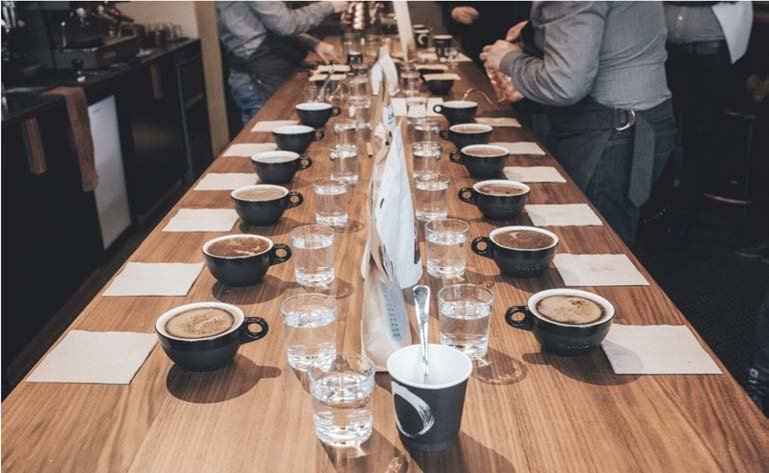
Two Paths to Tasting
Choose the level of depth that makes sense for you. There's no right or wrong!
Home Tasting
For those who want to better enjoy their daily coffee, without formalities. Just pay attention and have fun!
Simple and practical - Use your usual equipment
No pressure - There's no right or wrong
Focus on pleasure - Learn at your own pace
Zero cost - No need to buy anything new
Recommended for: Beginners, curious people, anyone who wants to appreciate coffee better without complications
Professional Cupping
For those who want to evaluate coffees technically and in a standardized way, following international protocols.
Rigorous methodology - Standardized SCA protocol
Scoring sheet - Objective evaluation criteria
Common language - Precise communication between professionals
Calibration - Continuous training and comparison
Recommended for: Professionals, producers, buyers, advanced enthusiasts
The Five Senses in Tasting
Tasting isn't just about taste. We use all our senses to evaluate coffee!
Sight
Color, transparency, grind uniformity, presence of visible defects, crema (in espresso).
Smell
Dry aroma (ground coffee), wet fragrance (after adding water), aromatic intensity and complexity.
Taste
The 5 basic tastes: sweet, sour, bitter, salty, and umami. Foundation for identifying complex flavors.
Touch
Body, texture, viscosity, oiliness, astringency, and tactile sensation in the mouth (mouthfeel).
Hearing
Sound of grinding, crackling of beans, extraction noise — indicators of quality and freshness.
How to Taste Coffee at Home
A simple step-by-step guide to start paying attention to what you're drinking
Prepare Two Coffees
Use the same brewing method (French Press, Aeropress, Hario V60, etc.) but with two different coffees. They can be from different origins, different roasts, or different processing methods.
Tip: Start with a coffee you already know and a new one. This makes comparison easier!
Smell Before Drinking
Bring your nose close to the cup and breathe deeply. What do you feel? Chocolate? Fruits? Nuts? Don't worry about getting it right — just pay attention.
Tip: much of what we call "flavor" comes from smell! That's why the aroma is so important.
Slurp and Spread
Take a sip, but don't swallow immediately. "Chew" the coffee (yes, it seems strange!) to spread it throughout your mouth. This helps identify different flavors.
Tip: Professionals "slurp" the coffee forcefully (it makes noise!), but you can do it more discreetly.
Compare and Note
Alternate between the two coffees. Which is sweeter? More acidic? Fuller-bodied? Write down your impressions — even if they're simple words like "tasty," "watery," "strong."
Tip: Over time, your vocabulary will naturally evolve. Don't force it!
The Secret to Developing Your Palate
It's not about having a "special" palate, but rather paying attention. The more you taste consciously, the more your brain learns to identify nuances. It's like learning a new language — you start recognizing basic words and, over time, understand complex sentences!
Cupping Protocol (SCA)
The professional method standardized by the Specialty Coffee Association
Preparation
• 8.25g of coffee per cup (medium grind) • Water at 93°C (±1°C) • 1:18 ratio (coffee:water) • 150ml cups, preferably white • Neutral environment, without external odors
Dry Aroma (Fragrance)
Smell the dry ground coffee before adding water. Identify intensity and initial aromatic characteristics. Rate from 0 to 10 on the form.
Adding Water
Pour hot water over the coffee, saturating all grounds evenly. Wait 4 minutes for complete infusion. A crust will form on the surface.
Breaking the Crust
With a cupping spoon, break the crust formed on the surface with gentle movements. This is the moment of greatest aromatic intensity (Aroma). Bring your nose close and inhale.
Surface Cleaning
Remove foam and floating particles with two spoons. Wait for the coffee to cool to approximately 70°C (about 8-10 minutes after adding water).
Tasting (Slurping)
Slurp the coffee forcefully (it makes noise!) to create a mist in your mouth and spread it across all taste buds. Evaluate at different temperatures: hot, warm, and cold.
SCA Evaluation Form
Understand the criteria used by professionals to score coffees (scale from 0 to 100)
Fragrance / Aroma
Fragrance = smell of dry coffee (ground) Aroma = smell of wet coffee (after water)
Flavor
Main flavor characteristics. It's the "overall impression" of the coffee in the mouth.
Aftertaste
How long does the flavor persist after swallowing? Is it pleasant or does it disappear quickly?
Acidity
Brightness and liveliness. It's not sourness! It's the refreshing sensation (like lemon or green apple).
Body
Weight and texture in the mouth. Can be light (like tea), medium, or full-bodied (like whole milk).
Balance
How do the elements harmonize? Does any attribute negatively dominate the others?
Sweetness
Perception of natural sweetness (not sugar!). Specialty coffees tend to be sweet.
Uniformity
Do the multiple cups evaluated have consistency? Are they all equally good?
Clean Cup
Absence of defects or strange flavors. Is the coffee "transparent" and without interference?
Overall
Personal and subjective evaluation of the taster. Would you drink this coffee again?
How Does Scoring Work?
Each category is worth up to 10 points. Adding everything up, you get 100 points. There are also defects that subtract points (bad flavors, impurities, etc.).
80-84.99 pts
Very Good
85-89.99 pts
Excellent
90+ pts
Exceptional
Coffees with less than 80 points are not considered "specialty" by the SCA.
Exercises to Train Your Palate
Simple practices to develop your ability to identify flavors
Direct Comparison
Prepare two coffees side by side and compare directly. Alternate between them several times.
Objective: Develop your ability to perceive subtle differences
Triangulation
Prepare 3 cups: 2 identical, 1 different. Try to identify which one is different.
Objective: Train your precision and concentration
Tasting Journal
Write down your impressions of each coffee you drink. Review later to see your evolution.
Objective: Build sensory memory and vocabulary
Extra Tip: Food Training
You can train your palate outside of coffee too! Try eating fruits, chocolates, nuts, and spices with full attention, trying to describe each flavor. This builds your sensory database.
Examples: Blueberry, raspberry, 70% chocolate, roasted almond, cinnamon stick, orange, etc.
Frequently Asked Questions
Common questions about coffee tasting
Do I need to spit out the coffee during tasting?
It depends on the context. In professional tastings (cupping), it's common to spit to avoid consuming excess caffeine (there can be 20+ samples!). In home tastings, you can swallow normally. The important thing is to evaluate the aftertaste.
Can I do cupping alone or do I need a group?
Yes, you can! Many people do cupping alone at home. The group is useful for calibrating your perceptions and exchanging impressions, but it's not mandatory. Start alone and, if you like it, look for local enthusiast groups or coffee shops that organize sessions.
How long does it take to develop a good palate?
There's no fixed timeframe. You'll notice improvements in weeks if you practice regularly. With 3-6 months of conscious practice, you'll already have a well-developed palate. But it's a continuous process — even professionals with decades of experience continue learning!
Do some people naturally have a better palate?
Yes and no. There are genetic variations (like "supertasters" who have more taste buds), but the most important thing is training and attention. Anyone can develop an excellent palate with practice. It's like learning a musical instrument!
Why do professionals make so much noise when tasting?
It's the "slurping" technique! By forcefully slurping the coffee, you create a mist that spreads throughout your mouth and also sends aromas to your nose (via retronasal olfaction). This intensifies flavor perception. It's not bad manners — it's sensory science!
Can I add sugar or milk during tasting?
For learning, better not. Sugar and milk mask the original flavors of the coffee. For technical tasting, always use pure coffee (nothing added). After evaluating, you can add whatever you want to drink! But first, give pure coffee a chance.
Factors Affecting Tasting
Variables that influence your sensory perception
Temperature
Flavors reveal themselves at different temperatures. Some stand out when hot, others when warm or cold. Therefore, evaluate coffee at multiple temperatures — you'll discover different nuances at each stage!
Hydration
Stay hydrated and cleanse your palate between samples with neutral water (preferably still and at room temperature). This "resets" your taste buds and prevents residual flavors from interfering.
Environment
Avoid external odors, noise, and distractions. Strong perfumes, food in the environment, excessive noise — all of this can interfere with concentration. Ideally, taste in a quiet space without smells competing with the coffee.
Physical State
Avoid tasting when sick, with a stuffy nose, after heavy meals, or after brushing your teeth (mint interferes!). Your physical and emotional state directly affects your sensory perception.
Let's learn more?